If you look up at the sky on different days, you’ll see that the Moon looks different and then seems to ‘reset’ after a month – why is that? And does the Moon look the same all around the world? If you want to find out more, dig in.
TL;DR
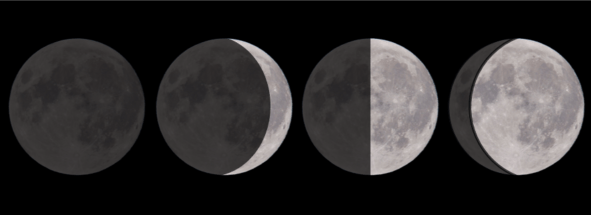
The Moon is not its own light source; it reflects light from the Sun. At all times, one half of the Moon is illuminated by the Sun and the other half is dark; the boundary between these two halves is called the lunar terminator. As the Moon orbits the Earth, we see a varying portion of the sunlit half of the Moon versus the dark half. For example, during the full moon we see all of the sunlit half and none of the dark half. At the crescent moon we see a sliver of the sunlit side and a lot of the dark side. The amount of the sunlit side that we can see from Earth at any time dictates what lunar phase the Moon is currently in.
LOOKING CLOSER
A common misconception is that the Moon always rises when the Sun sets – this is in fact only true during the full moon. The time at which the Moon rises depends on what lunar phase it is currently in; the lunar phases in order are: new moon, waxing crescent, first quarter (half moon), waxing gibbous, full moon, waning gibbous, last quarter (half moon), waning crescent and back to new moon.

During the new moon, the illuminated half of the Moon faces the Sun and the unilluminated half faces us, the Earth; this makes it seem as though there is no moon. As the Moon must be between the Earth and the Sun for this to happen, this also means that the Moon moves with the Sun, rising and setting alongside it.
Then, as the Moon moves along its orbit a little, we start to see a small amount of the sunlit side; this lunar phase is the waxing crescent, where ‘waxing’ means growing. At this point, the Moon will rise and set a bit after the Sun. The Moon moves further along its orbit and the lunar terminator sweeps along the surface of the Moon – hasta la vista, crescent moon – until the next lunar phase, which is the half moon. At this point, if you took a straight line between the Earth and the Sun and a straight line between the Earth and the Moon, they would be perpendicular – this 90 degree angle means that the Moon is a quarter of the way through its orbit, lending the half moon its other name, ‘first quarter’. When the Moon is three-quarters of the way through its orbit, there is another half moon called ‘third quarter’ or ‘last quarter’. During this lunar phase (and if you’re lucky enough to have a cloudless day), you will be able to see the half moon in the sky during the day.

After the half moon, we start to see more than half of the sunlit side of the Moon and this lunar phase is called ‘waxing gibbous’. Next is the full moon, when the sunlit half of the Moon completely faces us and the dark half faces away. The Earth is now in between the Sun and the Moon, so the Moon rises when the Sun sets and the world of physics briefly makes sense again.
You may be asking yourself, why doesn’t an eclipse occur at every new and full moon when the Sun, Earth and Moon are aligned? This is a very good question. It turns out that the Moon’s orbit around Earth isn’t perfect; it is elliptical and tilted at a 5-degree angle with respect to the orbit of the Earth around the Sun. This means that during the new and full moon, the Moon is often a bit above or below the spot where it needs to be for an eclipse. About four to seven times a year, everything comes together just right and we get an eclipse, but these are often partial rather than total.
Another important thing to note is that the side of the Moon that will be sunlit depends on which hemisphere you’re in on Earth. In the Northern Hemisphere, when you see the left side of the Moon as being dark, it means that the Moon is waxing and when you see the right side as dark, it means that the Moon is waning. This is the opposite in the Southern Hemisphere, where you are ‘upside-down’ (of course, if you live in the Southern Hemisphere, it is the Northern Hemisphere that is upside-down to you). If you are near the Equator, the lunar terminator will be horizontal during a half moon and the crescent moon will look like a dish.

Interestingly, if you were on the moon (tell us your secret!) then the Earth would also go through phases but in the reverse order i.e. when there is a new moon there is a ‘full Earth’ and a gibbous moon corresponds to a ‘crescent Earth’. This would be a very impressive sight; if you were on the side of the Moon that faces Earth, then the Earth would look over forty times brighter than the full moon does in the night sky and the Moon would be bathed in bluish light. This phenomenon is called ‘earthshine’ or ‘earthlight’ and we can best see it on Earth a few days before and after the new moon. At this point, the moon will have a sunlit crescent and the rest of it will be illuminated by indirect sunlight from Earth. This phenomenon was a mystery for centuries and humans called it “the old Moon in the new Moon’s arms” until none other than Leonardo da Vinci solved the riddle in the 16th century.


 DASH PHYSICS