

The exploration of Mars has been going on for 50 years, from the Mars 3 and Viking 1 landers of the Soviet Union and NASA in the 1970s, to CNSA’s Tianwen-1 and NASA’s Perseverance rovers today. Throughout this time, the search for liquid water has been key, so much so that NASA’s motto for the Mars Exploration Program is “Follow the water”. With the knowledge from previous missions and the arrival of two new rovers on the Martian surface this year, these next few decades are set to be a very exciting time for space exploration.
The Red Planet is our closest neighbour and was at the forefront of extra-terrestrial suspicions in our Solar System for a long time. The belief that the planet is populated by an intelligent civilisation of Martians began with Giovanni Schiaparelli’s observation of natural channels in the Martian landscape which he called “canali”; this was mistranslated by Percival Lowell to mean “canals” which he believed formed part of a complex irrigation system. This inspired science fiction from notable authors such as H.G Wells, Ray Bradbury and C.S Lewis, which only reinforced these beliefs in the public.
It’s true that there are many similarities between Earth and Mars – they are a similar distance from the Sun, both have an axial tilt, polar ice caps and a similar rotational period – but the big question has always been whether liquid water can be found on Mars.
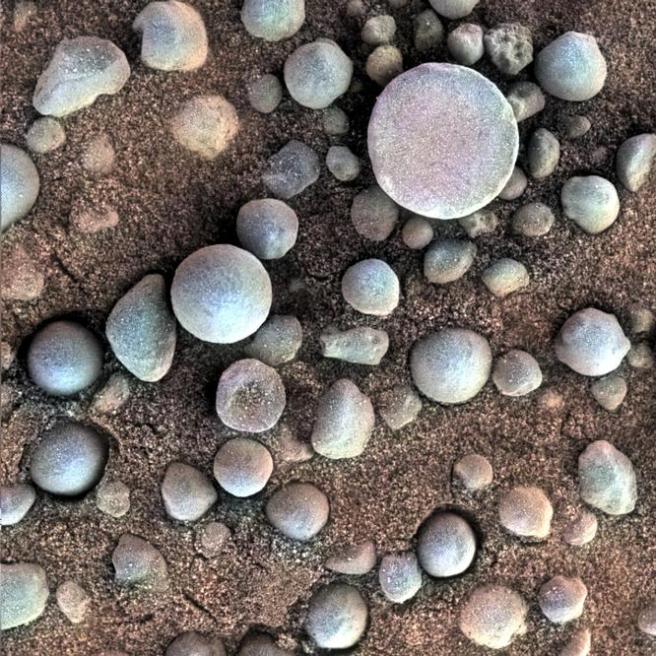
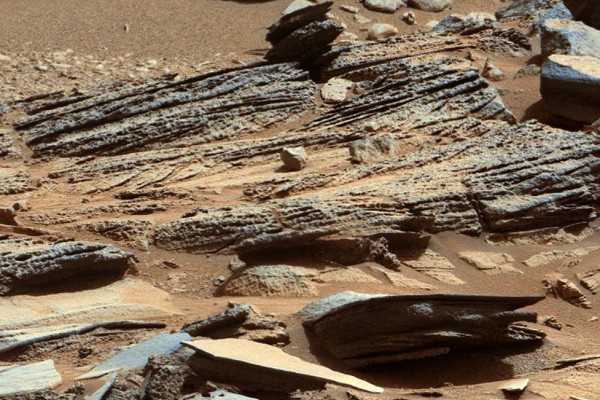
There is strong evidence that liquid water did once flow on Mars, billions of years ago when it was a much warmer and wetter planet with a thick atmosphere capable of retaining liquid water. NASA’s Opportunity rover found hematite and jarosite, minerals which are known to form in very acidic water. Although most known life would struggle to survive in such a low pH environment, acid-loving organisms on Earth thrive in these conditions, for example in the acid pools of Yellowstone National Park. Indentations in Martian rocks of a characteristic “cross-bed” shape are also only formed in flowing water.
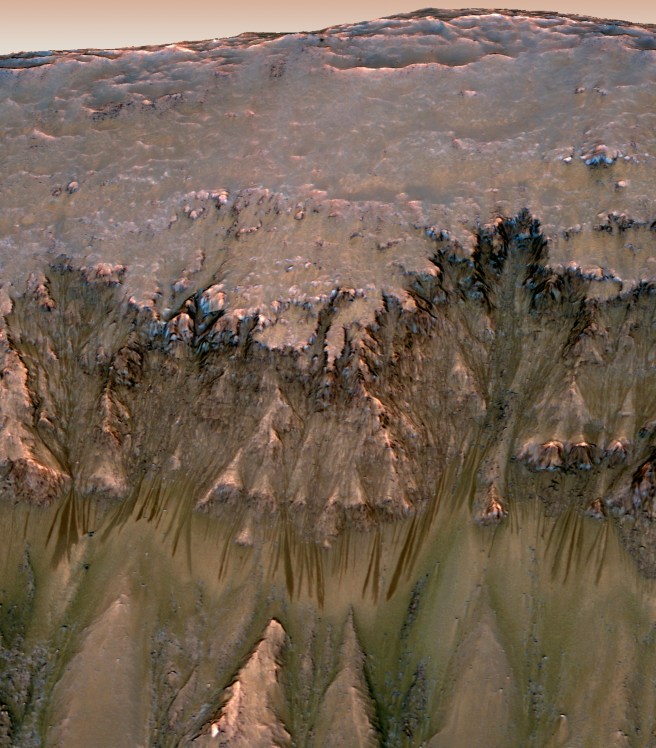
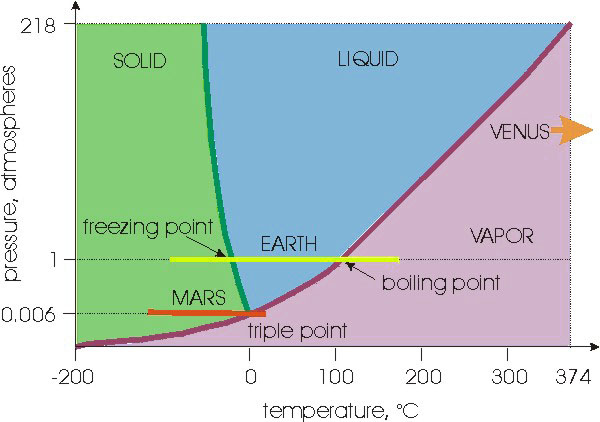
Today, it appears that there are no stable bodies of liquid water on the surface of Mars. The atmospheric pressure on Mars is so low that it is usually physically impossible for liquid water to exist on the surface, and under regular Martian conditions, water can only switch between its ice and vapour phases, skipping over liquid (see Fig. 1). However, if the temperature and pressure increase slightly, for example on a warm summer’s day, it is possible for liquid water to form very briefly. At first, this phenomenon was thought to be what created the dark streaks on steep slopes, or “recurrent slope lineae”, observed on Mars in 2011, but later analysis suggested that these were actually formed by the movement of grains.
If water used to flow on Mars and now it doesn’t, where did all the water go? The lack of a thick atmosphere, ozone layer or magnetic field means that high energy solar and cosmic radiation bombards the surface and can split up water molecules into hydrogen and oxygen. Mars, being relatively small and light, doesn’t exert enough gravity to retain the light hydrogen, which escapes into space. The oxygen reacts with iron on the surface to form iron oxide, otherwise known as rust, which gives Mars its red colour.
So liquid water does not seem to presently flow on the Martian surface. All hope is not lost, however, if we go underground. In 2018, ESA reported that their Mars Express spacecraft had detected what appeared to be a 20km wide subglacial lake of salty liquid water, submerged 1.5km beneath the southern polar ice cap of Mars. This discovery was confirmed in 2020 and three more surrounding subglacial lakes were found too. It’s suspected that the water – no warmer than -10°C – is kept from freezing by the pressure of the ice above and the presence of dissolved salts such as magnesium, calcium and sodium which vastly reduce the temperature at which the water freezes.
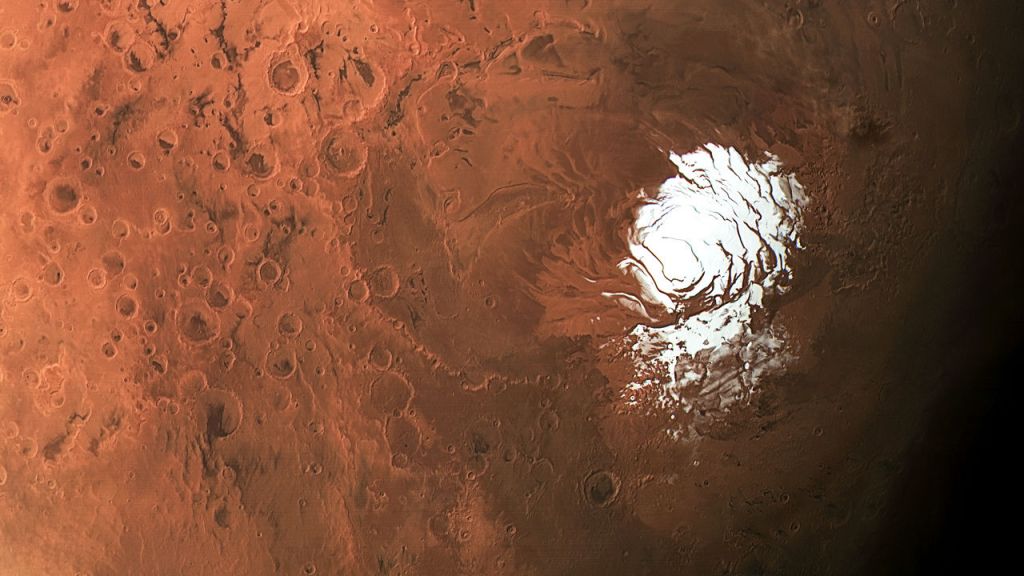
The presence of a stable body of liquid water containing chemical structures such as minerals is encouraging in the search for past or even present life on Mars. As we’ve seen, the Martian surface is not protected from harsh incoming radiation which would disrupt forming cell structures, whereas subsurface life would not have to worry about this. Furthermore, extremophiles – organisms that thrive in extreme environments – on Earth are known to inhabit salty subglacial lakes similar to the one on Mars, for example in Lake Vida. As these microbes have no access to sunlight, they have found other energy sources to maintain their own complexity, possibly extracting energy from the molecular hydrogen formed in the chemical reactions between the salty water and iron-rich sediments. If life ever existed in Mars’ subglacial lakes, it is likely that it would resemble the extremophiles inhabiting Lake Vida.
This is some of what we can gather so far about Mars, but we are on the cusp of finding out a lot more. NASA’s Perseverance rover will shortly be landing in the dry Jezero crater, thought to have once been an enormous lake during Mars’ early warm and wet phase. If life did exist in this ancient lake, it is possible that biomarkers from these organisms fell to the bottom of the lake and were preserved in the soil, which “Percy” will investigate. Percy will also collect rock and soil samples from the Martian surface which will be brought back to Earth for the first time. Another objective of the mission is to test oxygen production from the Martian atmosphere, paving the way for future human exploration on Mars.

 DASH PHYSICS