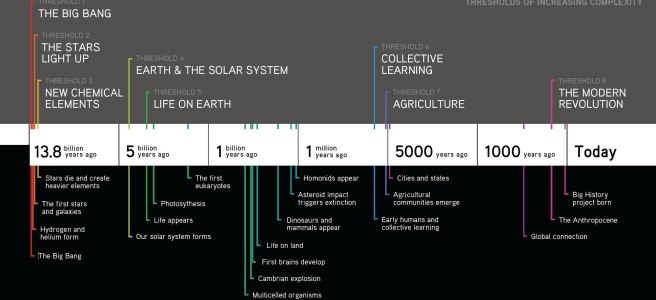
Here’s the entire history of the universe in one paragraph: The Big Bang creates the universe and all the matter within it, which slowly accumulates due to gravity until the birth of the first stars, which forge new chemicals and expel these into the cosmos when they die, forming the seeds for planets such as Earth on which these chemicals can combine to form increasingly complex compounds, which begin to seek resources to sustain themselves in a process called life, which evolves until our species emerges, with the ability of collective learning allowing us to harness increasing energy from the world around us and eventually dominate the planet on which we live. Phew.
This is Big History, whose goal is to summarise the entire history of our universe, all 13.8 billion years of it. Throughout the universe’s existence, the flow of energy and the presence of the right ingredients and ‘Goldilocks conditions’ have allowed the emergence of something new, a transition point which increases complexity in little niches of the world. According to Big History, there have been 8 of these transition points, or ‘thresholds’: the Big Bang, the birth of the first stars, the creation of new chemical elements, the formation of our Solar System and the Earth, the emergence of life, the emergence of Homo sapiens (a species capable of collective learning), agriculture and the modern revolution. Naturally, not everything over the span of almost 14 billion years can be studied in detail, so Big History chooses to focus on these thresholds.
Threshold 1: The Big Bang ~ 13.8 billion years ago
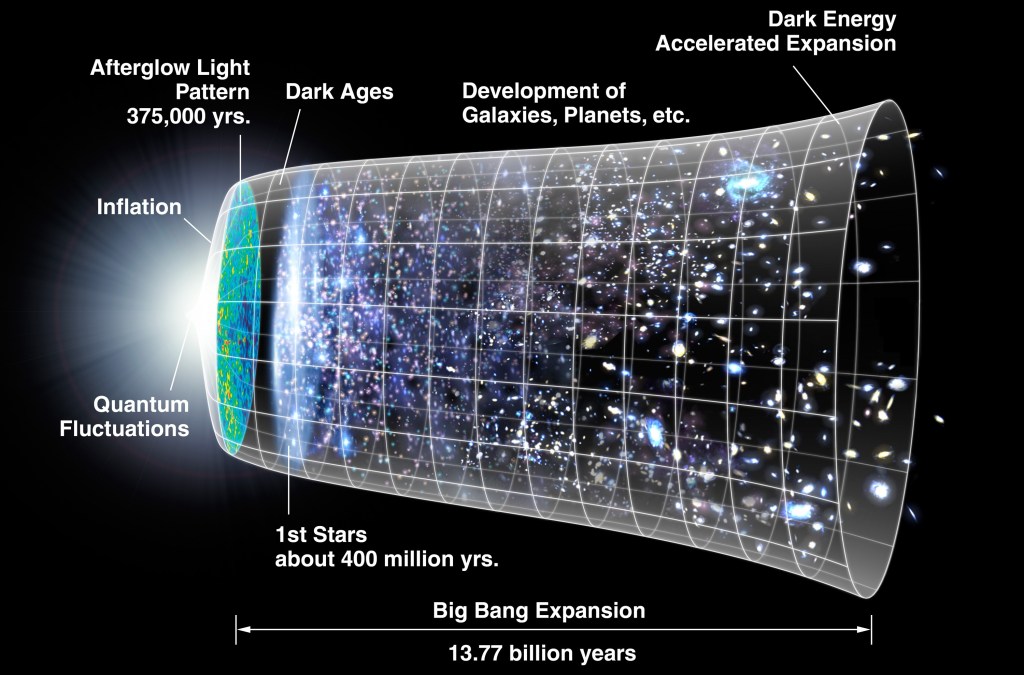
There was nothing, and then suddenly the Big Bang created the universe and everything within it – space, time, energy and matter. All of the matter and energy in the universe was packed into an unimaginably hot and dense area trillions of times smaller than the head of a pin. In the tiniest fraction of a second, the universe exploded outwards and expanded by a factor of 1026 in a process known as inflation. All the quantum fluctuations, the tiny, random wrinkles in the structure of the universe before it expanded, were amplified. It was so hot that atoms couldn’t form, in fact, not even protons could form; the universe was filled with a hot “quark-gluon plasma”, a hot sludge of all the tiniest building blocks of atoms. As the universe began to cool ever so slightly to 1015 degrees (Fahrenheit, Celsius, Kelvin, take your pick at that point they’re all pretty much the same), these tiny building blocks were able to come together and form protons and neutrons. Three minutes after the Big Bang, these protons and neutrons combined to form hydrogen and helium nuclei. The universe had to cool for another 370,000 years before nuclei and electrons could come together and form atoms, an event known as ‘recombination’. Recombination released high energy photons which are still travelling throughout the universe today, their wavelength having been stretched out so much by the expansion of the universe that they are now microwaves; these form the cosmic microwave background. If you have an analogue radio, 1% of the static that you hear in between stations is that first light of the universe reaching Earth.
Threshold 2: Stars & Galaxies ~ a few hundred million years after the Big Bang
The universe at this time was almost entirely filled with hydrogen and helium atoms. Inflation had taken all the little irregularities in the universe, where the tiniest particle had been a fraction of a nanometre closer to its neighbour on the right than on the left, and expanded them out so that the universe had regions of space that were more packed with matter than others. These denser clumps of gas experienced more gravity and so attracted more matter, which experienced increasing gravity and so on. Although the universe was expanding overall, gravity was stronger than the expansion in these dense clouds and they continued to amass surrounding matter. Gravity squashed these gas clouds so tightly that the heat and pressure within them began to grow: at 3,000 degrees Celsius, the protons and electrons split up again to form nuclei; at 10 million degrees Celsius, hydrogen nuclei began to fuse into helium nuclei, releasing huge amounts of energy and creating the first star.
Gravity continued acting on these massive stellar nurseries, pulling together neighbouring stars and forming galaxies, and then pulled galaxies together to form clusters and superclusters. The universe, which had once been a hot sludge, was now an interconnected web of galaxies containing massive gas clouds with hot, fusing stars at their centre.

Threshold 3: New Chemical Elements ~a few million years after the first stars
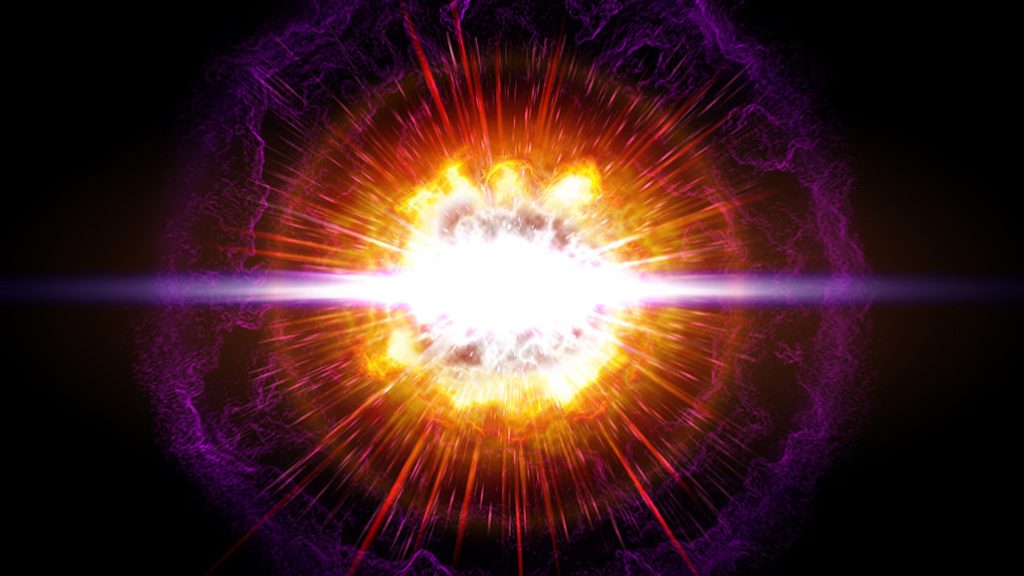
The universe was now physically and structurally complex but chemically very simple being almost completely made of hydrogen and helium. To become chemically complex, the universe had to wait for its first stars to die. The largest, most massive stars, which had greedily sped through their supply of hydrogen in just a few million years, were the first to go. A star is essentially a hydrogen bomb held together by gravity; it is a constant battle between the energy released from fusion pushing outwards and the force of gravity from its large mass pulling inwards. When the star’s fuel begins to run out, gravity starts to win and the star begins to contract; more mass is being squeezed into a smaller volume, so the pressure and heat in the star’s core increases, enabling the star to fuse new, heavier elements. The most massive stars continue this cycle, fusing helium into carbon, then carbon into oxygen and so on until iron. Energy cannot be gained by fusing iron so there is no more possible fuel to use; the star is defeated, and collapses. All of the elements created by the dying star crash into the core, and the temperature and pressure are raised even higher than before, creating brand new elements which are hurled outwards into the cosmos as the star violently explodes in a blinding flash known as a supernova. Supernovae enrich the universe with new elements, injecting these into gas clouds where new stars and planets may be formed.
Threshold 4: Formation of the Solar System ~4.6 billion years ago
The next threshold skips almost 9 billion years. Our galaxy, the Milky Way, has formed. A cloud of matter in one of the spiral arms of the Milky Way begins to collapse under its own gravity, increasing the temperature and pressure in its centre, until 99.9% of the matter in the cloud is concentrated in a hot spot where nuclear fusion occurs: the Sun is born, 4.6 billion years ago. The Sun’s hot radiation blasts away lighter elements such as hydrogen and helium, which are able to cool and condense only when they are far away from the Sun, forming the gas giants. The heavier elements that managed to stand their ground begin to cluster due to gravity. Over the next 100 million years, these clumps collide with increasing violence, with the largest clumps amassing more matter until they dominate their orbit, eventually forming the inner terrestrial planets, including our Earth, about 4.5 billion years ago.
The early Earth was not a friendly place. It was bombarded by frequent and violent meteorite and comet collisions, which are likely to have deposited organics and water molecules but also made the Earth melt due to the heat from their impacts. This led to a differentiation of the Earth’s structure: the heaviest elements fell to the bottom of the Earth and formed its core, creating a magnetic field that protects the surface from harsh solar radiation; other heavy elements formed the mantle and began moving in convection currents to cool off; lighter elements formed a thin, fragmented crust on top of the moving mantle, resulting in plate tectonics; the lightest gases such as carbon dioxide and water vapour, were spewed out of volcanoes and formed the atmosphere. Once the Earth had cooled down, the water vapour condensed and fell in huge downpours about 4 billion years ago that formed the first oceans, where life is believed to have begun.

Threshold 5: Life Begins ~ 3.8 – 4 billion years ago
It is uncertain where, how or when exactly life begun. A widely-accepted hypothesis is that life emerged in the warm water surrounding hydrothermal vents on the ocean floor. The chemicals and minerals released by the vents mixed with the hot rock and water, forming monomers that were the building blocks of life such as amino acids, which then polymerised to form cells which actively sought out resources to sustain themselves: life. About 3 billion years ago these organisms floated to the top of the ocean and began photosynthesising, releasing oxygen into the ocean and atmosphere. Over billions of years, these single-celled organisms became more specialised and complex and began working together, eventually becoming so co-dependent that they combined to form multicellular organisms about 600 million years ago. Life began to move from the ocean to the land, evolving into “endless forms most beautiful” over hundreds of millions of years and through 5 mass extinctions. From 230 to 65 million years ago, dinosaurs dominated the Earth and mammals were small burrowers that survived by staying out of their way. But 65 million years ago, an asteroid impact led to the extinction of the dinosaurs and enabled mammals to flourish and diversify into many different forms, such as primates, our ancestors.

Threshold 6: Collective Learning ~250,000 years ago
Primates emerged in Africa 25 million years ago; they lived in trees, with two forward-facing eyes to give them stereoscopic vision and unusually large brains to process visual information. Eventually, primates began living on the ground; the last common ancestor between chimps and humans lived 7 million years ago and was bipedal, freeing up its hands. Over 2 million years ago, the species Homo habilis emerged, the first to shape and use stone tools; Homo ergaster erectus followed shortly and began tinkering with these tools. Our species, Homo sapiens, emerged about 250,000 years ago in Africa, and our arrival on Earth is another threshold in Big History. It might seem ridiculously self-centred to suggest that the emergence of our species should be a major transition point in the 13.8 billion year old history of the universe, but it is because there is one thing that sets us apart from all other known species: collective learning. Collective learning is the ability to use efficient language to accumulate information throughout generations i.e. to retain more information in one generation than is lost by the next. It is the reason why over 250,000 years, humans have gone from foraging, using hand axes and painting in the Lascaux cave to spreading across the globe, building pyramids and designing rockets that flew us to the Moon. Collective learning has allowed Homo sapiens to evolve in a cultural sense on a much more rapid timescale than the biological evolution which other species are restricted to.

Threshold 7: Agriculture ~ 10,000 years ago
By the end of the last Ice Age 11,000 years ago, the human population had grown and migrated into four, separate world zones: Afro-Eurasia, Australasia, the Pacific and the Americas. The warming climate enabled foragers to settle down in areas where vegetation and animals flourished, allowing the population to grow until humans were forced to use their knowledge to extract more resources from their environment: agriculture. Agriculture is the first instance of a species adapting their environment to suit their needs rather than adapting themselves to their environment, and it represents a huge increase in the amount of energy and resources accessible to humans. Agriculture appeared in all world zones along rivers, beginning with Mesopotamia and the Indus Valley, and would have started simply, for example weeding out unhelpful plants and diverting streams and rivers to grow useful plants, or eliminating animals regarded as pests and protecting animals which could be used. The domestication of animals led to a huge increase in the energy available to humans: a human can do work at a rate of 75 watts, whereas an ox has a power of 750 watts. The advent of writing 5,000 years ago in Mesopotamia enabled knowledge to be conserved, leading to a boom in collective learning. This contributed to the invention of increasingly complex farming technologies, such as the wheel and plough, which increased the productivity of agriculture.
As agriculture became more efficient, communities were able to generate a food surplus, meaning that not everybody had to farm in order for everyone to be fed; this freed people up to pursue other jobs, leading to a diversification of labour. In direct analogy to the emergence of the first multicellular organisms, individuals became so specialised in their different jobs that they became completely dependent on each other. At the head of these complex societies, leaders used resources from taxation to protect the community and impose their will using paid enforcers; this represents the emergence of the first states. To feed their increasingly large populations, agrarian civilisations underwent military expansion, inventing new technologies such as roads and weapons along the way. At territory borders, merchants of different cultural groups connected and collective learning in the Afro-Eurasian world zone boomed with trade routes such as the Silk Road and Indian Ocean Trade network enabling not only goods, but ideas and unfortunately diseases to travel throughout the continents.

Threshold 8: The Modern Revolution ~ 1500 onwards
European trade with Asia was blocked by the Ottoman Empire after they conquered Constantinople in 1453, leading to Christopher Columbus being commissioned by the Spanish crown to find a new route to Asia by sailing west; instead, he found the Americas. This, and other voyages, mark the beginning of the connection of previously separate world zones. Since then, competitive commercial markets in this newly-created global exchange network have led to innovations in technology that have sharply increased collective learning.
In the 1700s, Britain turned to coal as a cheap source of energy and used steam engines to pump water out of flooded mines as they dug deeper. James Watt improved the steam engine to convert the natural energy from burning fossil fuels into immense mechanical power, beginning the Industrial Revolution. Steam engines were used in textile factories and revolutionised transportation with steamships, steam locomotives and railways. New methods of communication such as the telegraph, telephone and radio have allowed for the more rapid and global exchange of ideas, boosting collective learning across the world. Industrial societies grew rapidly in population, wealth and power, and used their growing wealth and modern military technologies to successfully colonise agrarian civilisations in the Americas, Africa and Asia, often through brutal means. Colonial empires and mounting nationalism contributed to chaos and two world wars in the 20th century, during which man also developed nuclear weapons capable of wiping out humanity.
The modern revolution continues today: breakthroughs in science and technology in the last century have not only lowered the death rate and freed billions from famine and disease, but also allowed us to become increasingly connected as a species and led to new understanding about the planet we live on and the universe around us.

The Near Future: Threshold 9?
Today, I can communicate instantaneously from London with someone in New York City and see them in person in just a few hours, a journey which would have taken months in the 1600s and would have been unthinkable 5,000 years ago. Although the wealth disparity has increased, average living standards are at an all time high in human history, with many living better than the kings of the Middle Ages. There is mostly widespread (and unprecedented) agreement on human rights and territory borders and many of us are lucky to live in a period of relative peace.
How long can we expect this growth in population, information and energy consumption to continue? After all, there are challenges facing humanity: a growing and ageing population, climate change and dwindling resources to name a few. Perhaps as a continuation of the Modern Revolution, new innovations in science and technology spurred by global collective learning will provide solutions to these problems, such as ongoing research on renewable energy sources. Or maybe the next few centuries will see the complexity that has accumulated for the last 250,000 years of human history culminate into a new threshold to do with artificial intelligence or, in analogy to globalisation from 4 separate world zones, extra-terrestrial colonisation. Although we can speculate about our near future, nothing is certain.
The Distant Future
Somewhat non-intuitively, the distant future is easier to predict than the near future. In a few billion years, the Sun will begin to run out of hydrogen and become a red giant, its outer edge swelling up to the Earth’s orbit and boiling away any life remaining. In a few hundred billion years, the accelerating expansion of the universe will make it impossible to see light from galaxies outside the Milky Way, ending the “golden age of astronomy”. Little by little, the universe will shed its complexity and simplify as stars flicker out over trillions of years, being absorbed by or becoming black holes. The continued expansion of the universe will spread free energy so thinly that complex forms will not be able to do work; eventually, atomic matter will decay into energy. Entropy will increase until the universe reaches thermodynamic equilibrium, and “not with a bang but a whimper”, the universe will celebrate its Heat Death.
The idea of a universal history has been pursued for at least a century, but ‘Big History’ is a term coined by David Christian, who teaches the course at Macquarie University. You can learn about it on the Big History Project website, the YouTube channel Crash Course, or on Coursera.

 DASH PHYSICS